
Latest research: Gut health trends
Mushroom gummies for gut health: what the evidence says
Mushroom gummies made with lion's mane, reishi, chaga and other functional mushrooms are often sold with gut-health wording. Lab and animal studies suggest some mushroom fibres can feed gut bacteria, but human research is small and early, and we found no trials of mushroom gummies themselves. Eating more fibre from everyday food has much stronger evidence.
Short on time? See what we recommend for gut health instead ↓
The short answer
- Functional mushrooms such as lion's mane, reishi, chaga, cordyceps, shiitake and maitake are now widely sold as gummies, often with gut-health wording.
- Mushrooms contain fibres called beta-glucans that gut bacteria can ferment. Most of the gut research is in lab dishes and animals, with only a few small human studies.
- We found no human trials showing that mushroom gummies, or the two products we looked at, improve gut health.
- Both brands headline 2,500 mg per serving, but it is split across many mushrooms: 250 mg of each of 10 for Ankhway, and 25 to 75 mg of extract each for Mighty. Human studies used grams, such as 3 g a day of lion's mane powder, so these amounts are likely too low.
- There are no authorised UK health claims for mushrooms, including for gut health. Reishi, chaga and maitake can interact with some medicines, including blood thinners.
- Eating more fibre from food, towards the NHS target of 30 g a day, has much better evidence for gut health.
What are mushroom gummies?
Mushroom gummies are chewable food supplements made with extracts of "functional" mushrooms. These are mushrooms used for their possible health effects, not just as food. The most common are lion's mane, reishi, chaga, cordyceps, shiitake, maitake and turkey tail. Some, like reishi, have a long history in traditional Chinese medicine. Others, like shiitake, are also everyday cooking mushrooms.
Gummies have become a popular way to take them. Mushroom powders can taste bitter and earthy, and not everyone likes swallowing capsules. A gummy tastes more like a sweet, and brands make the most of that: one says its gummies taste "like a good raspberry sweet". The trade-off is that a small chewy sweet can only hold so much extract. That matters when you compare gummies with the amounts used in research.
Which mushroom gummies are marketed for gut health?
Most mushroom gummies are sold mainly for focus, energy or calm, but gut health often appears in the list of benefits. Below are two popular UK brands that use gut-health wording on their own product pages. This isn't a review or a ranking. We set out what each brand says and what the label shows, then look at the research.
Short on time? See what we recommend for gut health instead ↓
Ankhway Mushroom Gummies
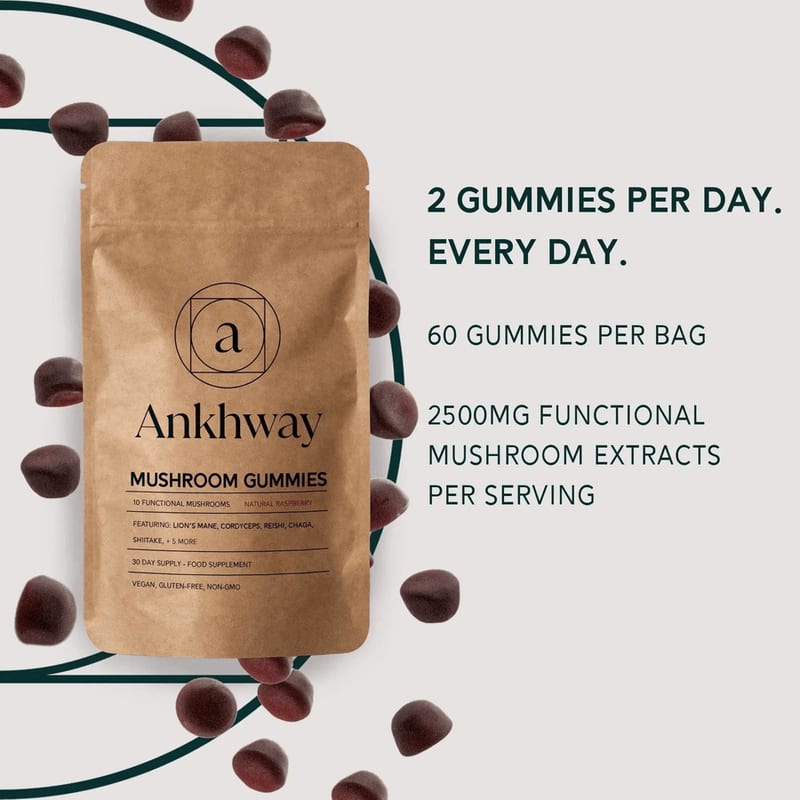
Ankhway is a London-registered company. Its raspberry gummies contain 10 mushrooms. The product page lists "Mushroom Extracts (250mg each)": lion's mane, cordyceps, chaga, maitake, shiitake, reishi, tremella, royal sun, black fungus and white button. The serving is 2 gummies a day, and a product image gives "2500mg functional mushroom extracts per serving", with 60 gummies in a bag. The brand says it uses fruiting body extract (the cap and stem, rather than the root-like mycelium). We couldn't find the extract ratio, the type of cordyceps or the beta-glucan content on the page.
The other ingredients begin with glucose syrup, sugar and glucose, followed by pectin, citric acid, natural raspberry flavour and a few others. The FAQ explains that the brand chose sugar over sweeteners for taste. We couldn't find a sugar figure per serving on the page.
The gut wording includes "Stronger Immunity, Healthier Gut" and "improve gut health for optimal daily wellness". Shiitake is described as "Protects your gut and promotes healthy digestion", and white button mushroom as "Promotes healthy digestion & gut health". A timeline on the page says that by month 1, "Digestion improves, bloating reduces, and gut health strengthens".
Mighty Mushroom Gummies
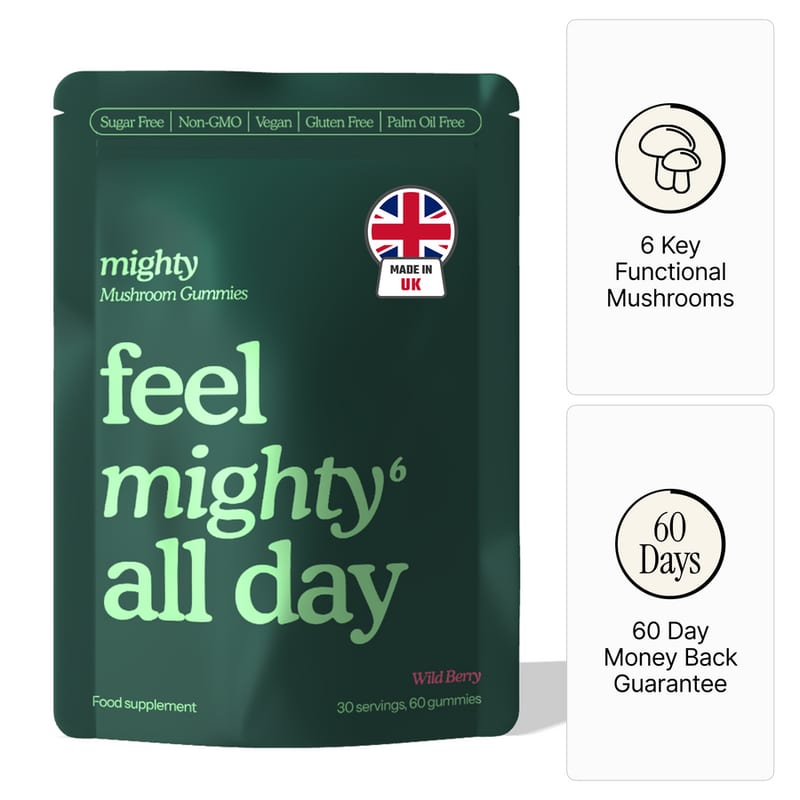
Mighty says its wild berry gummies are made in the UK. They contain six mushrooms, and the brand publishes a full nutrition panel. A serving is 2 gummies, with 30 servings in a pouch. Per serving, the label lists:
| Mushroom | Extract per serving | Label's "equivalent" amount |
|---|---|---|
| Lion's mane | 75 mg (10:1 extract) | 750 mg |
| Cordyceps (Cordyceps militaris) | 50 mg (10:1) | 500 mg |
| Reishi | 50 mg (10:1) | 500 mg |
| Chaga | 25 mg (10:1) | 250 mg |
| Maitake | 25 mg (10:1) | 250 mg |
| Shiitake | 25 mg (10:1) | 250 mg |
The label's headline figure is a "total daily serving" of 2,500 mg, which is the dried-mushroom equivalent. The actual extract adds up to 250 mg per serving. A "10:1" extract means roughly 10 parts of dried mushroom went into 1 part of extract, which is how the label reaches its larger figures: lion's mane, for example, is listed as 750 mg "from 75 mg 10:1 extract". The panel shows 0 g of sugars and 4.6 g of polyols (sugar alcohols used as sweeteners) per serving, at 10 kcal. The ingredients are xylitol, pectin, purified water, citric acid, sodium citrate, raspberry extract, malic acid, natural raspberry flavouring and carnauba wax. We couldn't find the beta-glucan content.
The gut wording sits under a "Gut & Immunity" heading: "Chaga, Maitake and Shiitake quietly support your gut and immune system, at the root!" Maitake is also labelled "Gut Health". The headline benefits are focus, energy and calm.
Both pages carry customer reviews that mention less bloating or better digestion. These are personal accounts, not controlled studies, so they can't show whether the gummies caused the change.
Do mushroom gummies work for gut health?
We found no human trials showing that mushroom gummies, or either product above, improve gut health. The research that does exist is on the mushrooms or their extracts. Most of it is in lab dishes and animals, with a handful of small human studies.
Beta-glucans and the prebiotic idea
Mushroom cell walls contain fibre-like carbohydrates, mainly beta-glucans. Reviews of the research explain that these resist digestion, so gut bacteria can ferment them into short-chain fatty acids, which help keep the gut lining healthy. That makes mushroom fibres possible prebiotics (food for helpful gut bacteria).
The reviews are also clear about the limits. A 2026 review pointed to big differences between mushroom preparations and a shortage of well-designed human trials. Another 2026 review of fungal beta-glucans said appropriately sized, standardised human trials are lacking. Much of the work is test-tube based. A 2020 study of shiitake fibre, for example, fermented it with human gut bacteria in the lab, not in people.
Is turkey tail good for your gut?
Turkey tail has the best-known human gut study. In a 2014 randomised trial, 24 healthy volunteers took PSP (a turkey tail extract), the antibiotic amoxicillin, or nothing. PSP led to "clear and consistent" changes in gut bacteria that the researchers said fit a prebiotic effect. But the study was small, in healthy people, and measured bacteria rather than symptoms. The trial record lists 1,200 mg three times a day, or 3,600 mg a day, for 14 days. Neither gummy above lists turkey tail.
Is lion's mane good for your gut?
Most lion's mane gut research is in animals. In a 2017 study, rats with chemically induced bowel inflammation had less gut damage and more helpful bacteria after taking lion's mane extracts.
One small human pilot study, from 2021, gave 13 healthy adults 1 g of lion's mane powder three times a day (3 g a day) for a week. Their gut bacteria became more varied, with more bacteria that make short-chain fatty acids. There was no comparison group, it lasted seven days, and it measured microbes, not how people felt. A 2025 systematic review found that the human trials of lion's mane have mainly looked at memory and thinking, not digestion.
For comparison, Mighty's label lists 75 mg of lion's mane extract per serving, and Ankhway's page lists 250 mg. Extracts and whole powders aren't directly comparable, so an exact match isn't possible. But both are well below the 3 g of powder used in the pilot study.
Reishi, shiitake, maitake and chaga
The gut evidence for these is earlier still. A well-known 2015 study found that a water extract of reishi mycelium changed gut bacteria and reduced weight gain in mice on a high-fat diet. That was in mice, and it used mycelium, while both brands say they use fruiting body. In a search of research databases, we found no human trials of reishi, shiitake, maitake or chaga that measured gut bacteria or digestive symptoms.
How much of each mushroom is in a gummy?
Not much. Both brands headline 2,500 mg per serving, but that figure works differently for each, and it is spread across many mushrooms. Ankhway's 2,500 mg is split across 10 mushrooms, so each one gets 250 mg a day, and the page doesn't say whether that is extract or a dried-mushroom equivalent. Mighty's 2,500 mg is a dried-mushroom equivalent: the actual extract is 250 mg, split across six mushrooms at 25 to 75 mg each (its largest, lion's mane, is listed as 750 mg "from 75 mg" of extract).
The human studies above used grams, not milligrams: about 3 g a day of lion's mane powder and 3,600 mg a day of a turkey tail extract. Extracts and powders can't be compared exactly, but at these amounts each mushroom is likely too small a dose to match what has been studied, even before you consider that the studies themselves were small and early.
What do UK rules say about mushroom health claims?
In Great Britain, food supplements can only make health claims listed on the GB nutrition and health claims register. The register lists several mushroom claims, such as shiitake for the immune system and reishi for exhaustion, all marked as non-authorised. We found no authorised claim for any mushroom, and none about gut health. Advertising Standards Authority (ASA) guidance from 2024 says the same: "there are no authorised claims for mushrooms themselves".
Some mushrooms also count as "novel foods". These are foods not eaten to a significant degree in the UK or EU before 15 May 1997, which need approval before they can be sold. The ASA guidance says the Food Standards Agency is likely to consider turkey tail and Cordyceps militaris unauthorised novel foods. Mighty's label lists Cordyceps militaris. Ankhway's page doesn't say which cordyceps it uses. This position can change if an authorisation is granted.
Are mushroom gummies safe?
Most people seem to tolerate functional mushrooms well, but a few points are worth knowing.
- Medicines. Memorial Sloan Kettering's herb database says reishi can raise the risk of bleeding with blood thinners such as warfarin, and isn't advised with medicines that suppress the immune system. Maitake has been linked to a warfarin interaction in a case report and may add to the effect of diabetes medicines. Chaga may do the same with blood thinners and diabetes medicines, based on lab studies. Both gummies contain reishi, maitake and chaga, and both brands advise checking with a healthcare provider if you take other medicines.
- Rare reactions. There are case reports of liver injury with reishi powder, and of kidney damage from oxalates in people who took large amounts of chaga for months. Lion's mane has been linked to stomach discomfort, nausea and skin rash in a clinical study.
- Pregnancy and breastfeeding. We found little safety research on these extracts in pregnancy or breastfeeding, so it's sensible to speak to your midwife, GP or pharmacist first.
- Teeth. The NHS says sugar is one of the main causes of tooth decay, and suggests keeping sugary foods to mealtimes. If your gummies contain sugar, having them with a meal is an easy habit.
- Sweeteners and sensitive tummies. Sugar-free gummies often use polyols. If you have IBS, the NHS suggests avoiding sorbitol, which is one type of polyol.
If you have gut symptoms that don't settle, a GP is the best first step, rather than a supplement.
What has better evidence for gut health?
Fibre from food. Government guidelines say adults should eat 30 g of fibre a day, but most of us manage only about 20 g. Good sources include wholegrains and oats, wholemeal bread, potatoes with their skins, beans, lentils and chickpeas, vegetables, and fruit. Cooking with mushrooms is one tasty way to add variety, alongside other plant foods.
For practical ideas, see our guides to the best foods for gut health and a gut-healthy lifestyle.
If you'd like a supplement as well, fibre-based products have greater evidence for supporting gut health. In our gut health supplements ranking, the top two are both built around fibre: FOCUL Gut + Mind, led by PHGG, a gentle fibre studied in people with IBS, as well as ingredients to support the gut-brain connection, which has growing evidence for how stress affects the gut; and the Myota Gut Health Fibre Blend.
The bottom line
Mushroom gummies are an easy, pleasant way to take functional mushrooms, and the science on mushroom fibres and gut bacteria is genuinely interesting. But it's early. Most of it comes from lab and animal studies, the human studies are small and used larger amounts, and we found no trials of the gummies themselves. If gut health is your goal, more fibre from a varied diet is the step with the strongest evidence behind it.
This is general information, not medical advice. See a GP if your symptoms are new, severe or getting worse, or if you notice blood in your poo or lose weight without trying. Don’t stop or change a prescribed medicine without speaking to your GP or pharmacist.
Questions people ask
- Do mushroom gummies help gut health?
- There isn't good evidence that they do. Lab and animal studies suggest some mushroom fibres can feed gut bacteria, but we found no human trials of mushroom gummies for gut health. The few human studies of mushroom extracts were small, short and used larger amounts than most gummies contain.
- Is lion's mane good for your gut?
- It might affect gut bacteria, but the evidence is early. Most gut studies are in animals. One small 2021 pilot study gave 13 healthy adults 3 g of lion's mane powder a day for a week and found more varied gut bacteria, but it had no comparison group and didn't measure symptoms.
- Is turkey tail good for gut health?
- A 2014 trial in 24 healthy volunteers found that an extract from turkey tail, taken at 3,600 mg a day for two weeks, changed gut bacteria in a way that suggested a prebiotic effect. It was small and measured bacteria, not symptoms. UK advertising guidance says the Food Standards Agency is likely to treat turkey tail as an unauthorised novel food.
- Are mushroom gummies safe?
- Most people seem to tolerate them, but some mushrooms can interact with medicines. Reishi, chaga and maitake may add to the effects of blood thinners such as warfarin, and maitake and chaga may add to diabetes medicines. Speak to a pharmacist or GP first if you take any regular medicine, or if you're pregnant or breastfeeding.
- Do mushroom gummies have sugar in them?
- Many do. Of the two we looked at, Ankhway's gummies list glucose syrup, sugar and glucose as their first ingredients, while Mighty's gummies use polyols (sugar alcohols) and list 0 g sugars. The NHS advises keeping sugary foods to mealtimes to protect your teeth.