
THERA Nordic REZCUE review
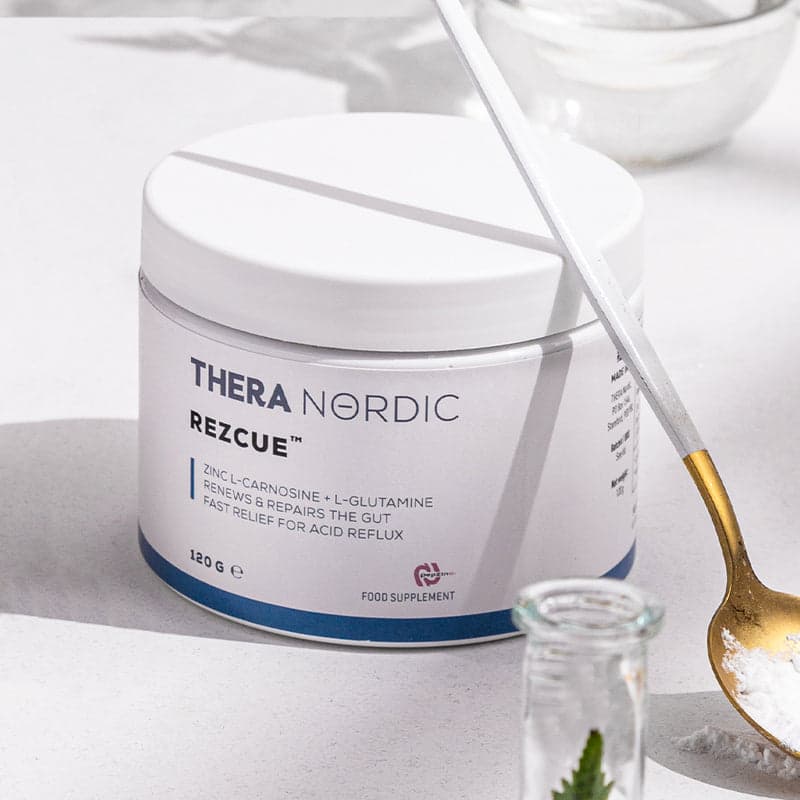
THERA Nordic REZCUE, often searched for as 'Nordic Rescue', is a two-ingredient drink powder: zinc carnosine and L-glutamine. Two scoops a day give 16 mg of zinc, 59 mg of L-carnosine and about 4.9 g of glutamine. The zinc carnosine amount matches two small UK studies on gut permeability, and glutamine is a key fuel for the cells that line the gut, though neither has been tested for reflux. At £29.95 for a 24-day tub it costs about £1.25 a day.
The short answer
A simple, fully labelled two-ingredient powder with zinc carnosine at the amount used in small UK gut studies, though it hasn't been tested for reflux and zinc carnosine's novel-food safety review in Europe is unresolved.
- Per 2.5 g scoop: 8 mg zinc, 29.5 mg L-carnosine and 2,438 mg L-glutamine. The brand directs two scoops a day.
- The 120 g tub is sold as '48 servings', which is 24 days at the directed dose.
- Zinc carnosine at about 75 mg a day matches two small placebo-controlled UK studies on gut permeability, and it is used at higher amounts as a medicine in Japan.
- Zinc carnosine is a novel food in Europe; EFSA could not confirm its safety in 2022 or 2026, and we found no GB authorisation.
- £29.95 one-off (about £1.25 a day); subscriptions take 15% off the first three orders and 22% after that.
See THERA Nordic prices and buy
- Best for
- People who want a simple, fully labelled two-ingredient formula; Anyone interested in zinc carnosine at the amount used in small UK gut studies; Vegans (the brand says it is suitable)
- Not for
- Anyone already taking another zinc supplement; People with kidney or severe liver disease (the brand advises against it); Pregnant or breastfeeding women, or children, without professional advice; Anyone hoping to replace prescribed reflux treatment
- Brand website
- theranordic.com
What we like
- Simple formula: two active ingredients, both fully labelled
- Zinc carnosine at the amount used in small placebo-controlled UK gut studies
- Glutamine, a key fuel for the cells that line the gut
- No fillers, flavours or sweeteners listed
- Made in GMP-compliant UK facilities, according to the brand
What we don’t
- Zinc carnosine is classed as a novel food: EFSA couldn't confirm its safety in 2022 or 2026, and we found no GB authorisation
- Limited research on zinc carnosine supporting the repair of oesophageal damage, and no trials of the product or either ingredient in reflux
- No named testing lab or published certificates of analysis
Our verdict
REZCUE is about as simple as gut supplements get: two ingredients, both fully labelled. Its main active, zinc carnosine, is taken at the same daily amount used in two small UK studies that found it limited increases in gut permeability (how "leaky" the gut lining is), and it is used at higher amounts as a medicine in Japan. The second ingredient, glutamine, is a key fuel for the cells that line the gut. It is a focused, sensible pairing.
The research is still limited, though. Neither ingredient has been tested for reflux, which is what the brand mainly promotes it for, and the gut studies were small and short. Zinc carnosine is also a novel food whose safety EFSA has twice said it could not establish. It is a supplement, not a medicine: it may suit adults who want a simple powder aimed at the gut lining, but it isn't a replacement for treatment from your GP.
What's in it
Each 2.5 g scoop contains, as labelled:
- 8 mg zinc and 29.5 mg L-carnosine, supplied as a zinc carnosine complex (L-carnosine plus zinc acetate)
- 2,438 mg L-glutamine, an amino acid
The brand directs one scoop twice a day, so the daily intake is 16 mg zinc, 59 mg L-carnosine and about 4.9 g glutamine. The zinc and carnosine figures are consistent with roughly 75 mg of zinc carnosine a day. The brand's FAQ calls 16 mg of zinc "106% of adult RDA"; against the 10 mg reference value used on UK labels it is 160%.
There are no flavours, sweeteners or fillers listed. The brand doesn't name its zinc carnosine supplier, so we can't confirm it is the same material used in the studies.
Novel food status. Zinc carnosine wasn't eaten in Europe to any significant degree before 1997, so it counts as a novel food and needs authorisation. EFSA reviewed it in 2022 and again in 2026 and both times said it couldn't establish its safety, mainly because of gaps in data on particle size and absorption. We found no GB authorisation on the Food Standards Agency's register. Zinc carnosine products are widely sold in the UK, and the brand doesn't comment on this.
What the research says
Zinc carnosine. In a 2007 UK study, 10 healthy volunteers took a painkiller (indomethacin) known to make the gut leakier. With placebo, gut permeability tripled; with 37.5 mg zinc carnosine twice a day, it didn't rise significantly. A 2016 study in 8 volunteers found zinc carnosine reduced the rise in gut permeability after hard exercise that raised body temperature by 2°C. Both used about this product's daily amount. They were small and short, so the evidence is promising rather than settled.
Zinc carnosine (polaprezinc) also has a long history as a medicine: it has been sold in Japan since 1994 for stomach ulcers. A 2022 trial in 224 people with stomach ulcers found it worked about as well as another ulcer drug, and a 2022 meta-analysis of three trials found that adding it to antibiotics improved H. pylori clearance. The EU novel food application proposes 150 mg a day for adults; REZCUE gives about half that, the amount used in the UK gut studies. Ulcers and H. pylori need diagnosis and treatment by a doctor, not self-treatment.
We found no trials of zinc carnosine for reflux or heartburn.
Glutamine. Glutamine is a key fuel for the cells that line the gut, which is why it is so often included in gut formulas. Research on it is mixed: a 2024 meta-analysis of 10 trials found no overall effect on gut permeability, while the best-known positive trial, in people who developed IBS after a gut infection, used 15 g a day. REZCUE's 4.9 g is an amount suited to everyday use alongside zinc carnosine.
As with any supplement, think of it as everyday support rather than a treatment, and see your GP if symptoms carry on.
Value for money
The 120 g tub costs £29.95. It is sold as "48 servings", but at the directed two scoops a day it lasts 24 days, so it costs about £1.25 a day. The 240 g tub (£57.95) works out at about £1.21 a day. Subscriptions take 15% off the first three orders and 22% after that, bringing the small tub to about 97p a day.
That is a little more than FOCUL Gut + Mind at about £1.17 a day one-off, cheaper than Myota and Spacegoods Rainbow Dust, both about £1.63–£1.67 a day, and a little above Fifth Ray Cosmic Hue at about 97p. For a mid-range price you get a short, fully labelled formula, with zinc carnosine at the amount used in the UK gut studies.
Who should take it (and who shouldn't)
It may suit adults who want to try zinc carnosine at the amount used in the UK gut studies, in a simple two-ingredient formula. It is not for people already taking zinc, since 16 mg a day plus another supplement could pass the NHS's 25 mg limit. The brand advises against it with chronic kidney or severe liver disease and suggests professional advice in pregnancy, breastfeeding or for children.
Zinc can block some antibiotics, and the brand says to separate it from thyroid medicine by at least an hour. Don't stop prescribed reflux medicine without talking to your GP. Heartburn most days, trouble swallowing or unexplained weight loss need a GP visit.
How to take it
Stir one scoop into warm, not boiling, liquid in the morning and again before bed. The brand says it works best on an empty stomach, but suggests a little food if it causes nausea.
The gut permeability studies lasted 5 to 14 days, and there is no reflux trial to guide how long to try it. If nothing has changed after a few weeks, it is reasonable to stop, and to see a GP if symptoms persist.
Alternatives worth considering
- FOCUL Gut + Mind: a multi-ingredient gut-and-mind powder with fibre, glutamine and DGL, at a slightly lower daily cost.
- Myota Gut Health Fibre Blend: a low FODMAP fibre blend if your main aim is more fibre.
- Fifth Ray Cosmic Hue: a herbal gut tea at a slightly lower daily cost.
- Spacegoods Rainbow Dust: a mushroom and adaptogen drink aimed at focus and energy.
Ingredients and doses
| Ingredient | Per serving | Studied dose | Grade |
|---|---|---|---|
| Zinc carnosine (L-carnosine + zinc acetate complex)Two small UK trials were positive at this dose, and it is used at higher amounts as a medicine in Japan. | Per scoop: 8 mg zinc + 29.5 mg L-carnosine (16 mg zinc + 59 mg L-carnosine a day) | 37.5 mg zinc carnosine twice a day (75 mg a day) in small gut-permeability studies; 150 mg a day as an ulcer medicine in Japan | Grade B: Good support |
| L-glutamineAn amino acid that the cells lining the gut use as a key source of fuel. | 2,438 mg per scoop (4,876 mg a day) | Studied at a wide range of amounts; some gut trials used much higher doses | Grade C: Some support |
- Third-party testing
- The brand says products are made in GMP-compliant UK facilities and laboratory tested. It doesn't name a testing lab or publish certificates of analysis.
- Allergens
- None declared. The brand says it is gluten free and non-GMO.
Safety notes
- Two scoops give 16 mg of zinc. The NHS advises no more than 25 mg a day from supplements unless a doctor advises it, so don't combine with other zinc products.
- High zinc intakes reduce copper absorption, which over time can lead to anaemia and weaker bones.
- Zinc can stop some antibiotics (quinolones and tetracyclines) being absorbed. Take the antibiotic at least 2 hours before, or 4 to 6 hours after, zinc.
- The brand says to leave at least an hour between REZCUE and thyroid medicine.
- The brand advises against use with chronic kidney disease or severe liver disease, and says to check with a practitioner in pregnancy, breastfeeding or for children.
- Nausea is the most common side effect the brand lists, especially on an empty stomach.
- Don't stop or change a prescribed acid-reducing medicine such as omeprazole without speaking to your GP. Heartburn most days, trouble swallowing or unexplained weight loss need a GP visit.
This is general information, not medical advice. Check with a GP or pharmacist first if you take medicines, are pregnant or breastfeeding, or have a health condition.
Questions people ask
- Is 'Nordic Rescue' the same as REZCUE?
- Yes. The product people often search for as 'Nordic Rescue' is REZCUE Drink Powder from the UK brand THERA Nordic.
- Does REZCUE help acid reflux?
- Zinc carnosine has been researched for supporting the gut lining, with small human studies on gut barrier function, and it is used as a stomach ulcer medicine in Japan. It hasn't been trialled in reflux yet. Think of REZCUE as everyday support rather than a treatment, and see your GP if you have heartburn most days.
- Is zinc carnosine allowed in the UK?
- Zinc carnosine is classed as a novel food, which means it needs authorisation before it can be sold as a food. EFSA reviewed it in 2022 and again in 2026 and couldn't confirm its safety, and we found no GB authorisation. The gut studies behind it are also small and short, so the evidence isn't conclusive yet.
- How long does a tub of REZCUE last?
- The 120 g tub holds 48 scoops. At the directed two scoops a day, that is 24 days. The 240 g tub lasts 48 days.
- How much zinc is in REZCUE?
- 8 mg per scoop, so 16 mg a day at the directed dose. That is 160% of the 10 mg reference value used on UK labels and under the NHS's 25 mg daily limit for supplements.
- Can I take REZCUE with thyroid medication?
- The brand advises leaving at least an hour between them. Zinc also interferes with some antibiotics, so check with a pharmacist if you take regular medicines.
Compare with
9.1
FOCUL Gut + Mind review
Includes ingredients that support the crucial gut-brain axis. Its standout ingredients are PHGG fibre, which has evidence for IBS, and DGL extract, which may support the soothing of the oesophagus and the protective mucosal lining of the digestive tract.
£1.17 a day
powder5.2
Spacegoods Rainbow Dust review
Mainly a caffeinated focus drink, with a meaningful caffeine dose and 300 mg of KSM-66 ashwagandha. Its gut fibre feels like an add-on: it appears in the coffee flavours only, in a modest amount, and it costs more per day than FOCUL Gut + Mind.
£1.63 a day
powder4.5
Fifth Ray Cosmic Hue review
An enjoyable, caffeine-free herbal tea that may offer gentle support, built around fennel and marshmallow root, two herbs with recognised traditional use for mild digestive discomfort; the amount of each herb isn't published, and several herbs need care in pregnancy, autoimmune conditions and with some medicines.
97p a day
tea8.2
Myota Gut Health Fibre Blend review
A gentle, Monash-certified low FODMAP fibre blend led by PHGG, a sensible daily top-up for sensitive guts, but at £50 for one bag as a one-time purchase it costs considerably more than FOCUL Gut + Mind (£34.99).
£1.67 a day
powder