
Spacegoods Rainbow Dust review
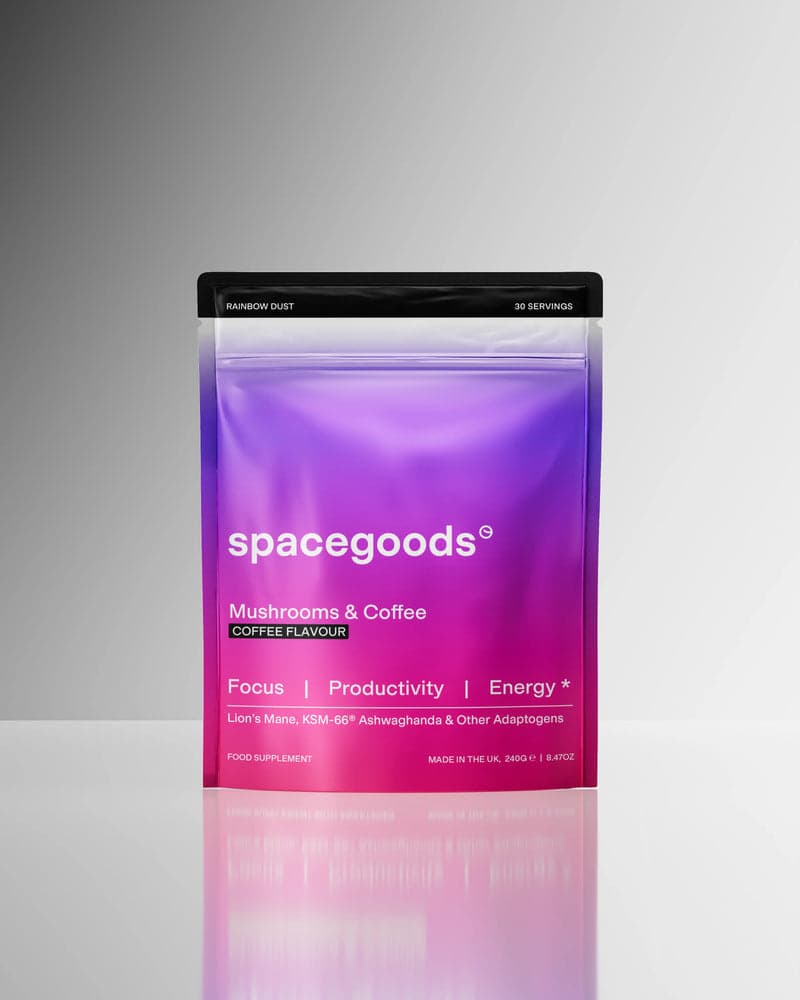
Spacegoods Rainbow Dust is an 8 g drink powder with 3 g of mushroom extracts (lion's mane, cordyceps and chaga), 300 mg of KSM-66 ashwagandha, 250 mg of maca, vitamin B5 and 80 to 120 mg of caffeine, depending on flavour. Spacegoods promotes it for focus and energy and, in its social media advertising, for gut health. The coffee flavours add chicory inulin, a prebiotic fibre, giving about 3.8 g of total fibre a serving, a modest amount for gut support. At £49 for 30 servings it costs about £1.63 a day.
The short answer
Mainly a caffeinated focus drink, with a meaningful caffeine dose and 300 mg of KSM-66 ashwagandha. Its gut fibre feels like an add-on: it appears in the coffee flavours only, in a modest amount, and it costs more per day than FOCUL Gut + Mind.
- Promoted for focus and energy and, in Spacegoods' social media advertising, for gut health.
- Every active is dosed on the label: 1,000 mg each of lion's mane, cordyceps and chaga extract, 300 mg KSM-66 ashwagandha, 250 mg maca, 6 mg vitamin B5.
- Caffeine is 120 mg in Coffee, 80 mg in most other flavours, and none is listed in Decaf.
- Chicory inulin, a prebiotic fibre, is the first ingredient in the coffee flavours (3.7 to 3.8 g total fibre a serving); Chocolate, Vanilla Cinnamon and Strawberry contain little or no added fibre.
- £49 one-off for 30 servings (about £1.63 a day); the page shows £29 a month on subscription.
- Best for
- Coffee drinkers who want a lower or steadier caffeine dose; People who want KSM-66 ashwagandha in a drink rather than a capsule; People who want some prebiotic fibre in their morning drink (coffee flavours); People who like full per-ingredient doses on the label
- Not for
- Anyone wanting a higher-fibre product mainly for regularity; People with IBS who find inulin causes wind or bloating; Pregnant or breastfeeding women; People with liver disease or a thyroid condition; Anyone sensitive to caffeine (choose Decaf, which still contains ashwagandha)
- Brand website
- spacegoods.com
What we like
- Every active ingredient has a stated dose per serving
- Extract ratios and fruiting-body sources are named
- KSM-66 ashwagandha at 300 mg, within the range used in stress trials
- Caffeine at a level that carries an authorised claim for alertness, listed for each flavour
- Coffee flavours include chicory inulin, a prebiotic fibre
- Vitamin B5 at 100% of the reference intake, with authorised claims
- Made in England, according to the brand
What we don’t
- Caffeinated: 80 to 120 mg a serving in every flavour except Decaf
- Fibre is modest (about 3.8 g total) and in the coffee flavours only; the inulin amount isn't stated separately
- Human research on the three mushrooms, which make up most of the actives, is still early
- 'Third-party lab tested' claim with no published certificates
- Costs more per day than FOCUL Gut + Mind
Our verdict
Rainbow Dust is a caffeinated drink powder built around functional mushrooms and ashwagandha. Spacegoods promotes it for focus and energy and, in its social media advertising, for gut health. Its best-supported ingredients are the caffeine, at a level that carries an authorised claim for alertness, and 300 mg of KSM-66 ashwagandha, an amount within the range used in stress trials. Lion's mane, cordyceps, chaga and maca are traditional ingredients whose human research is still early. Every active has its dose on the label, which is good practice.
For the gut, the fibre feels like an add-on rather than the main purpose of the drink. Chicory inulin, a prebiotic fibre, appears in the coffee flavours only, at about 3.8 g of total fibre a serving, and the inulin amount isn't stated separately. Research on the mushrooms for gut health is limited. Most flavours are also caffeinated, and it costs more per day than FOCUL Gut + Mind. If gut health is your main goal, FOCUL or Myota's Gut Health Fibre Blend is a closer fit. It is a supplement, not a medicine, so it isn't a replacement for advice from your GP.
What's in it
Each 8 g tablespoon contains, according to the label:
- 1,000 mg lion's mane (12:1 fruiting body extract)
- 1,000 mg cordyceps (20:1 extract; the brand says Cordyceps sinensis)
- 1,000 mg chaga (12:1 fruiting body extract)
- 300 mg KSM-66 ashwagandha root extract
- 250 mg maca root (10:1 extract)
- 6 mg vitamin B5 (100% of the daily reference intake)
- Caffeine: 120 mg in Coffee, 80 mg in Chocolate, Vanilla Cinnamon, Strawberry and Coffee Caramel, none listed in Decaf
Full doses for every active are a genuine plus. The extract ratios show how concentrated each mushroom extract is, but the label doesn't give beta-glucan content (the fibre-like sugars often used to judge mushroom extract quality).
The base changes a lot by flavour. In Coffee, Coffee Caramel and Decaf, chicory root fibre (inulin) is the first ingredient, giving 3.7 to 3.8 g of total fibre per serving. Chocolate is based on reduced-fat cocoa (2.7 g fibre, none of it added inulin). Vanilla Cinnamon and Strawberry are based on oat drink powder and contain just 0.1 to 0.3 g of fibre. We could not find a label for the Coffee Hazelnut flavour.
What the research says
Caffeine is the best-supported ingredient. EFSA found that 75 mg or more improves alertness and attention, which is the basis of an authorised claim, so 80 to 120 mg is a meaningful amount. This is most of what you will notice.
KSM-66 ashwagandha at 300 mg is within the 300 to 600 mg range used in stress trials. A 2022 meta-analysis of eight trials found lower stress and anxiety scores, though it rated the certainty of that evidence as low. We grade it B.
Lion's mane is a culinary mushroom studied in small trials for mental performance. A 2023 pilot study gave young adults 1.8 g of a fruiting-body extract: reaction time improved slightly an hour after one dose, with little change after 28 days. Rainbow Dust has 1,000 mg of a 12:1 fruiting-body extract. Cordyceps and maca are traditional ingredients with limited human research for focus or energy so far, and chaga has very little.
Chicory inulin is a prebiotic, a fibre that feeds gut bacteria. EFSA accepted that native chicory inulin increases stool frequency, based on 12 g a day; the coffee flavours give about 3.8 g of total fibre, so think of it as a modest top-up rather than a full fibre supplement. Inulin ferments quickly and can cause wind and bloating in sensitive guts, and a 2019 meta-analysis found prebiotics did not improve overall IBS symptoms.
Vitamin B5 at 6 mg carries authorised GB claims, for example that pantothenic acid contributes to normal mental performance and the reduction of tiredness and fatigue.
On regulation, chaga extract is listed as not novel when used in food supplements. The UK treats Cordyceps militaris as a novel food needing authorisation; Spacegoods says it uses C. sinensis instead. We could not verify the species independently.
Value for money
A 30-serving pouch costs £49, or about £1.63 a day. Two pouches cost £79 (£1.32 a day) and three cost £99 (£1.10 a day). The page currently shows £29 a month on subscription (about 97p a day).
That is more per day than FOCUL Gut + Mind (about £1.17 one-off) and about the same as Myota's fibre blend, which gives 9.8 g of fibre a scoop. Fifth Ray Cosmic Hue is cheaper but discloses no amounts. If you only want ashwagandha, Holland & Barrett's KSM-66 ashwagandha costs about 54p a day for 300 mg. With Rainbow Dust you are paying for caffeine, ashwagandha, vitamin B5 and three mushroom extracts in one drink, though the mushrooms are the part with the least research so far.
Who should take it (and who shouldn't)
It suits adults who want a coffee alternative with a moderate caffeine dose, a stated dose of KSM-66 ashwagandha and, in the coffee flavours, some prebiotic fibre.
Avoid it if you are pregnant or breastfeeding: the Food Standards Agency advises pregnant women and people with liver conditions to avoid ashwagandha supplements, and even Decaf contains 300 mg. Check with a pharmacist if you take thyroid, diabetes, blood pressure or immune-suppressing medicines, or sedatives. It is not suitable for under-18s. If you are sensitive to caffeine, choose Decaf. If you have IBS, the inulin in the coffee flavours may cause wind or bloating. New or worsening gut symptoms need a GP visit, not a supplement.
How to take it
Mix one tablespoon (8 g) with water or milk, hot or cold, ideally in the morning because of the caffeine. The brand says you can have up to three servings a day, but count all your caffeine: three Coffee servings is 360 mg before any other tea or coffee. The brand suggests at least 30 days, ideally 90, before judging it. Stop if you notice any unusual symptoms, such as stomach upset, tummy pain or yellowing skin or eyes.
Alternatives worth considering
- FOCUL Gut + Mind: a gut-and-mind powder with PHGG fibre and a complete label, at a lower daily cost.
- Myota Gut Health Fibre Blend: 9.8 g of fibre a scoop if more fibre is your main aim.
- THERA Nordic REZCUE: zinc carnosine and glutamine for the gut lining.
- Fifth Ray Cosmic Hue: a caffeine-free herbal tea for gentle everyday gut support.
Ingredients and doses
| Ingredient | Per serving | Studied dose | Grade |
|---|---|---|---|
| Lion's mane mushroom (12:1 fruiting body extract)One pilot trial found a faster reaction-time result after a single dose but little change over 28 days. | 1,000 mg | 1.8 g a day of a fruiting-body extract in a small 28-day pilot trial | Grade C: Some support |
| Cordyceps (labelled Cordyceps sinensis, 20:1 extract)A traditional mushroom with limited human research for focus or energy; the brand says it uses C. sinensis, not the C. militaris treated as novel in the UK. | 1,000 mg | Not established | Grade C: Some support |
| Chaga mushroom (12:1 fruiting body extract)A traditional mushroom; human research for focus, energy or gut health is still limited. | 1,000 mg | Not established | Grade D: Little support |
| KSM-66 ashwagandha root extract (12:1)A 2022 meta-analysis found lower stress and anxiety scores, but rated the certainty of evidence as low. | 300 mg | 300–600 mg a day of root extract in stress and anxiety trials | Grade B: Good support |
| Maca root (10:1 extract)A traditional root; research for focus, energy or gut health is limited. | 250 mg | Not established | Grade C: Some support |
| Caffeine (natural, from coffee)Does most of the work for the focus and energy the product is sold for. | 120 mg (Coffee); 80 mg (Chocolate, Vanilla Cinnamon, Strawberry, Coffee Caramel); none listed (Decaf Coffee) | 75 mg or more for alertness and attention (EFSA) | Grade A: Well established |
| Chicory root fibre (inulin)A prebiotic fibre; the amount isn't stated separately. | Not stated separately; total fibre 3.8 g (Coffee, Coffee Caramel), 3.7 g (Decaf); not an ingredient in Chocolate, Vanilla Cinnamon or Strawberry | 12 g a day of native chicory inulin for more frequent bowel movements (EFSA) | Grade C: Some support |
| Vitamin B5 (calcium D-pantothenate)Carries authorised UK health claims at this amount. | 6 mg (100% NRV) | Authorised claims apply at this level | Grade A: Well established |
- Third-party testing
- The brand says it is '3rd party lab tested' and that it tests for heavy metals and allergens, but we found no published certificates or batch results.
- Allergens
- None declared on the flavour labels we checked. Vanilla Cinnamon and Strawberry are based on a gluten-free oat drink powder.
Safety notes
- Caffeine: up to 120 mg a serving. EFSA considers up to 400 mg a day from all sources safe for most adults, and 200 mg in one go. Three servings of the Coffee flavour (360 mg) plus other coffee or tea could take you over.
- Pregnancy: the NHS advises no more than 200 mg of caffeine a day, and the Food Standards Agency advises pregnant women to avoid ashwagandha supplements. Skip this product, including Decaf.
- The Food Standards Agency also advises people with pre-existing liver conditions to avoid ashwagandha supplements while its safety review is completed.
- If you take thyroid, diabetes, blood pressure or immune-suppressing medicines, or sedatives, ask a pharmacist before using an ashwagandha product.
- Inulin is a fast-fermenting fibre and can cause wind and bloating, especially in people with IBS.
- Not suitable for children or teenagers because of the caffeine and ashwagandha.
This is general information, not medical advice. Check with a GP or pharmacist first if you take medicines, are pregnant or breastfeeding, or have a health condition.
Questions people ask
- Is Spacegoods Rainbow Dust good for gut health?
- Its gut-relevant ingredient is chicory inulin, a prebiotic fibre that feeds gut bacteria, in the Coffee, Coffee Caramel and Decaf flavours (about 3.7 to 3.8 g of total fibre a serving). That is a modest amount, and the fibre is an add-on to what is mainly a caffeinated focus drink. The other flavours contain little or no added fibre.
- How much caffeine is in Rainbow Dust?
- The labels list 120 mg per 8 g serving for Coffee and 80 mg for Chocolate, Vanilla Cinnamon, Strawberry and Coffee Caramel. No caffeine is listed for Decaf Coffee.
- Is the cordyceps in Rainbow Dust allowed in the UK?
- The brand says it uses Cordyceps sinensis, not Cordyceps militaris, which UK regulators treat as a novel food needing authorisation. We could not independently confirm which species or form is in the product.
- Can I take Rainbow Dust while pregnant?
- We wouldn't. The Food Standards Agency advises pregnant women to avoid ashwagandha supplements, and every flavour, including Decaf, contains 300 mg of KSM-66 ashwagandha.
Compare with
8.2
Myota Gut Health Fibre Blend review
A gentle, Monash-certified low FODMAP fibre blend led by PHGG, a sensible daily top-up for sensitive guts, but at £50 for one bag as a one-time purchase it costs considerably more than FOCUL Gut + Mind (£34.99).
£1.67 a day
powder4.5
Fifth Ray Cosmic Hue review
An enjoyable, caffeine-free herbal tea that may offer gentle support, built around fennel and marshmallow root, two herbs with recognised traditional use for mild digestive discomfort; the amount of each herb isn't published, and several herbs need care in pregnancy, autoimmune conditions and with some medicines.
97p a day
tea9.1
FOCUL Gut + Mind review
Includes ingredients that support the crucial gut-brain axis. Its standout ingredients are PHGG fibre, which has evidence for IBS, and DGL extract, which may support the soothing of the oesophagus and the protective mucosal lining of the digestive tract.
£1.17 a day
powder8.1
THERA Nordic REZCUE review
A simple, fully labelled two-ingredient powder with zinc carnosine at the amount used in small UK gut studies, though it hasn't been tested for reflux and zinc carnosine's novel-food safety review in Europe is unresolved.
£1.25 a day
powder